
Duct Leakage Testing for Title 24 Compliance
If you're replacing a furnace, condenser, coil, or ductwork in California, your permit almost certainly requires a duct leakage test by a certified third-party rater — it's the single most common HERS verification in the state. We pressurize the system per Reference Appendix RA3.1, give you the result on the spot, and register the CF3R with CHEERS the same day.
What is a duct leakage test?
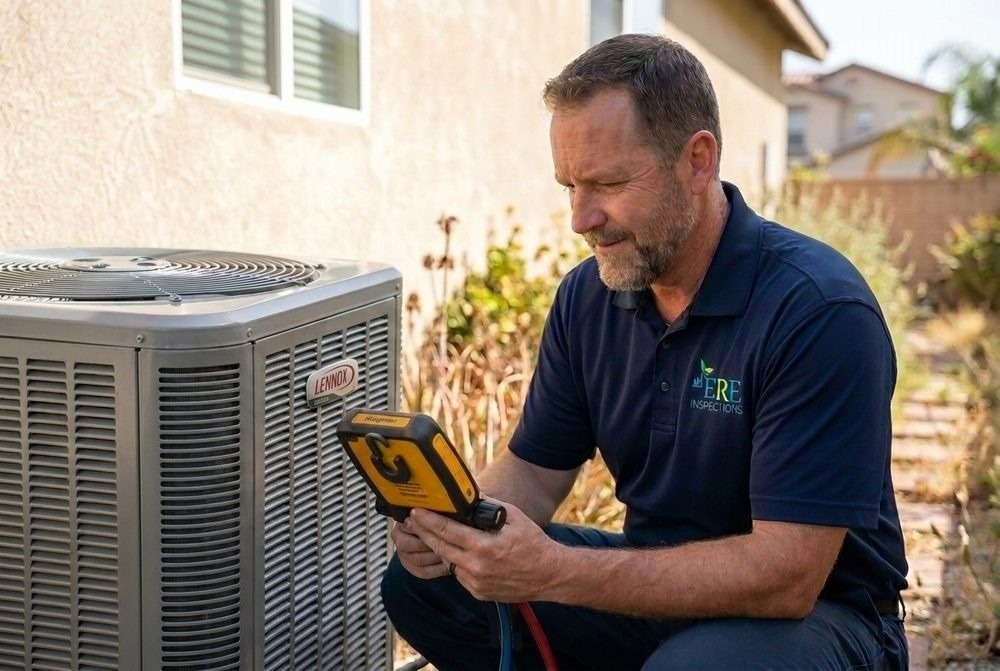
A duct leakage test measures how much conditioned air your duct system loses before it ever reaches a room. A certified HERS rater — HERS stands for Home Energy Rating System, the third-party verification program that California's Energy Code Compliance (ECC) program grew out of — seals off every register, connects a calibrated fan to the system, pressurizes the ducts to 25 Pascals, and reads the leakage in cubic feet per minute (CFM). The procedure is defined in Reference Residential Appendix RA3.1.4.3.1 of Title 24 — California's Building Energy Efficiency Standards, Title 24 Part 6 of the California Code of Regulations.
The result is compared against your system's nominal airflow — per RA3.1.4.2.2, that's 400 CFM per ton of cooling capacity, or 21.7 CFM per kBtu/hr for heating-only systems. A 3-ton air conditioner has a nominal airflow of 1,200 CFM, so a 5 percent leakage limit means the entire duct system may leak no more than 60 CFM under test pressure. Leaky ducts routinely waste 20 to 30 percent of the air they carry, which is exactly why the state checks.
When Title 24 requires a duct test
A HERS / ECC duct leakage verification is triggered when your project does any of the following:
- Replaces space-conditioning equipment. Swapping the outdoor condenser, cooling or heating coil, air handler, or furnace heat exchanger is an “altered space-conditioning system” under section 150.2(b)1E — the classic HVAC changeout, and the most common reason our phone rings.
- Installs more than 25 feet of new or replacement ducts. Section 150.2(b)1D sets the trigger at 25 feet under the 2022 code — tighter than the 40-foot rule many contractors remember from earlier code cycles.
- Installs an entirely new or complete replacement duct system. A full re-duct is held to the stricter new-system standard.
- Builds new. New single-family construction requires duct sealing and testing under section 150.0(m)11, verified before occupancy.
A handful of narrow exceptions exist — ducts located entirely within conditioned space, for example, follow their own verification procedure. Send us your CF1R (Certificate of Compliance, the energy design document filed with your permit) and we'll confirm exactly which tests apply. The full alteration text is on Energy Code Ace.
What counts as passing
The thresholds are set as a percentage of system air handler airflow, and they depend on the scope of work:
- 5% — new construction, and entirely new or complete replacement duct systems on alterations.
- 10% total leakage — altered or extended existing systems (the HVAC-changeout case).
- 7% leakage to outside — the alternate compliance path for altered systems, measured with a blower door running simultaneously.
- 6% — altered ducts located in a garage.
- Seal-and-verify fallback — if an altered system can't meet the numbers, all accessible leaks are sealed and the rater verifies the work through a visual inspection and a smoke test.
Those figures come straight from sections 150.2(b) and 150.0(m)11 of the 2022 Energy Code, as published by Energy Code Ace, the California statewide codes and standards training program. Knowing your target before the visit is half the battle — tell your installer which number applies and have them seal to it.
2022 vs 2025 code: what changed (and what didn't)
The 2025 Building Energy Efficiency Standards took effect January 1, 2026. The rule that decides which code applies is your permit application date: applications filed on or after January 1, 2026 follow the 2025 code; applications filed before that date stay on the 2022 code, even if the work happens later.
For duct testing specifically, the news is continuity: the California Energy Commission's (CEC) official What's New for 2025 fact sheet lists no change to the duct leakage thresholds — the 5/10/7/6 percent limits carry forward. What did change around the test:
- HERS raters are now ECC raters. The CEC renamed the compliance program Energy Code Compliance (ECC) effective January 1, 2026. Same test, same forms, new name — our raters are certified either way.
- Refrigerant charge verification expanded. Heat pump changeouts now require charge verification in all 16 climate zones, so a 2025-code changeout often bundles more measures into the same visit.
- Heat pumps are the prescriptive baseline for space heating in every climate zone, which means more electric changeouts — and the duct test rides along on nearly all of them.
What happens during the visit
- We seal the system. Every supply and return register is taped or plugged so the only way out is through leaks.
- We connect the fan. A calibrated duct pressurization fan (you may have heard “duct blaster”) attaches at the air handler or a central return.
- We pressurize to 25 Pascals and read the leakage in CFM directly off the gauge — the RA3.1 diagnostic procedure.
- We compare against your threshold. Pass or fail, you know before we're off the ladder. Most single-system tests take 30 to 60 minutes on site.
- We complete any other required measures on the same visit — refrigerant charge, cooling coil airflow, fan watt draw — whatever your CF1R calls for. See Title 24 HERS / ECC Rating for the full menu.
- We register the CF3R with CHEERS the same day. The CF3R (Certificate of Verification) is the registered document your building inspector checks against the installer's CF2R (Certificate of Installation) before signing off the permit. CHEERS is the CEC-approved ECC data registry we file through.
Why ducts fail — and how they get fixed
Roughly speaking, the same handful of problems cause most failed duct tests:
- Disconnected or torn flex duct — a connection pulled apart in the attic or crawl space, often at a takeoff or elbow. Fix: reconnect, strap, and seal with mastic.
- Unsealed boots at the registers — the metal boot isn't sealed to the drywall or subfloor, so the test air pours into the wall cavity. Fix: caulk or mastic the boot perimeter.
- Plenum and takeoff connections sealed with old cloth-backed tape that has dried out and let go. Fix: strip and re-seal with UL 181 mastic or mastic and mesh.
- Leaky air handler cabinet or filter slot — gaps at the cabinet seams and an ungasketed filter door count against you. Fix: foil tape rated for the application and a gasketed filter cover.
- Crushed or kinked flex runs that were patched instead of replaced. Fix: replace the run — sealing a failing duct is throwing mastic at a structural problem.
The sealing work is your HVAC contractor's job, not the rater's — a third-party verifier can't fix what it tests. But because we test hundreds of systems a year, we can usually point your installer at the exact leak class while we're still on site, which is the difference between a same-week retest and a stalled permit.
If it fails: the retest
A failed test isn't a failed project. We document the reading, brief you and your contractor on the likely causes, and come back to retest once the sealing is done. Smaller leaks are often sealed while we're still there, turning a fail into a pass in a single visit. Published market rates put retesting at around $125 per hour at firms that list it; ERE quotes any retest fee up front — before the first visit, not after the failure.
What a duct leakage test costs
Most Southern California HERS firms don't publish prices, but the market data is consistent. Cost guides and published rater price lists put a standalone duct leakage test at roughly $150 to $400 per visit, with the spread driven by property size, number of systems, and travel (sources: Title 24 Energy Experts, HomeAdvisor, Energyguru's published price list). A full HVAC-changeout package — duct leakage plus refrigerant charge, cooling coil airflow, and fan watt draw in one visit — runs roughly $200 to $450 in the same sources, with registry fees of about $50 sometimes added on top.
ERE doesn't do mystery pricing: call (310) 807-4800 or request a quote with your address and the scope on your permit, and you'll get a fixed number for the visit — tests, registration, and paperwork included — before we schedule anything.
Frequently asked
How much does a duct leakage test cost?
Market data for Southern California puts a standalone duct leakage test at roughly $150 to $400 per visit, and a full HVAC-changeout HERS package (duct leakage plus refrigerant charge, airflow, and fan watt draw) at roughly $200 to $450. Exact pricing depends on the number of systems and the tests listed on your CF1R. Call ERE at (310) 807-4800 for a fixed quote before we roll a truck.
How long does a duct leakage test take?
Plan on roughly 30 to 60 minutes per system on site. We seal the registers, pressurize the ducts to 25 Pascals with a calibrated fan, and read the leakage directly off the gauge. You get the result before we leave, and the CF3R is registered with CHEERS the same day.
What happens if my ducts fail the test?
We document the reading and walk you through the likely leak points — most failures trace to disconnected or torn flex duct, unsealed boots at the registers, or leaky plenum connections. Your HVAC contractor seals the leaks with mastic, and we retest. For altered systems that cannot reach the numeric target, Title 24 allows a fallback: seal all accessible leaks and have the rater verify the work with a visual inspection and a smoke test.
Do I need a duct leakage test for a furnace swap?
Usually, yes. Under Title 24 section 150.2(b), replacing the furnace heat exchanger, air handler, cooling coil, or outdoor condenser counts as altering the space-conditioning system, which triggers duct leakage testing by a certified HERS / ECC rater. A few narrow exceptions exist — send us your CF1R or permit scope and we'll confirm in minutes.
What leakage rate do I need to pass?
It depends on the scope. New construction and entirely new or complete replacement duct systems must test at or below 5% of system air handler airflow. Altered existing systems pass at 10% total leakage or 7% leakage to outside, and altered ducts in a garage must hit 6%. On a typical 3-ton system (1,200 CFM nominal), 5% is just 60 CFM of leakage.
Can I skip the test if my ducts are buried or inaccessible?
No — but Title 24 has a path for hard cases. If an altered system can't meet the numeric thresholds, all accessible leaks are sealed and a certified rater verifies the work with a visual inspection and a smoke test. Ducts located entirely within conditioned space are handled under their own verification procedure. Tell us what you're working with and we'll map the cleanest path.
Related Title 24 services
- Title 24 HERS / ECC Testing — Duct leakage, refrigerant charge, airflow, and fan efficacy — same-day registered results.
- Every HERS / ECC Measure — A field guide to every Title 24 measure we verify and when each is required.
- Title 24 Reports (CF1R) — Energy calculations and the Certificate of Compliance for your permit.
- Final Inspections & Closeout — We schedule the city inspector and close out your permit.
- QII Verification — Quality Insulation Installation inspections before drywall, per RA3.5.
Need a duct test for your permit?
Tell us the address and what's on the permit. We'll confirm which tests apply, quote a fixed price, test the system, and register the CF3R with CHEERS the same day — across LA, Orange County, and the Inland Empire.