
Every HERS / ECC Measure, Explained
Title 24 doesn't take your contractor's word for it. Certain energy measures — duct leakage, refrigerant charge, airflow, ventilation, insulation quality — must be verified in the field by a certified third-party rater before your permit can close. This page covers every measure: what it is, when it's required, how it's tested, and where the code says so.
How HERS / ECC verification works
Title 24 — California's Building Energy Efficiency Standards, Title 24, Part 6 of the California Code of Regulations — requires that certain energy measures be field-verified and diagnostically tested by a certified third-party rater. For years those raters were called HERS raters (Home Energy Rating System); under the 2025 Energy Code the California Energy Commission (CEC) renamed the compliance program Energy Code Compliance (ECC), so as of January 1, 2026 the same raters are ECC raters and the testing rules moved from Title 20 (California's appliance and administrative regulations) into Title 24's administrative section. Same tests, new name.
The paperwork chain is simple: your energy consultant's CF1R (Certificate of Compliance) lists which measures your project must verify; the installing contractor certifies their work on a CF2R (Certificate of Installation); and the rater tests each measure and registers a CF3R (Certificate of Verification) with an approved registry — ERE registers through CHEERS, a CEC-approved ECC provider and data registry. The building inspector checks the registered CF3Rs before signing your final.
One date matters: the 2025 Energy Code took effect January 1, 2026 and applies to permit applications submitted on or after that date. Earlier applications stay on the 2022 code — so two identical projects can need different tests depending on when the permit was filed.
Jump to a measure:
- Duct leakage testing
- Refrigerant charge verification
- Cooling-coil airflow
- Fan watt draw (fan efficacy)
- Blower door / envelope leakage
- Whole-dwelling ventilation & IAQ
- Kitchen range hood verification
- Quality Insulation Installation (QII)
- Heat pump water heater readiness
- PV and solar-ready notes
Duct leakage testing
What it is. The single most common HERS measure. Leaky ducts dump conditioned air into the attic or crawl space instead of your rooms, so Title 24 caps how much a duct system may leak and requires a rater to prove it.
When it's required. New duct systems, replaced duct systems, and most HVAC change-outs where ducts are extended or the air handler, coil, or condenser is replaced. New systems must leak no more than 5 percent of nominal system airflow; alterations commonly target 10 percent total leakage, with sealed-and-verified alternatives — your CF1R states the exact target.
How it's tested. We seal the registers, connect a calibrated duct-pressurization fan, bring the duct system to a 25-pascal test pressure, and measure the leakage flow as a percentage of system airflow.
Code: §150.0(m)11; test procedure in Reference Appendix RA3.1. Full details on our duct leakage testing page.
Refrigerant charge verification
What it is. A check that the air conditioner or heat pump holds the factory-correct amount of refrigerant. An over- or under-charged system loses capacity and efficiency while looking like it "works."
When it's required. This one grew under the 2025 code: refrigerant charge verification is now required for heat pumps in all 16 climate zones, and for air conditioners in climate zones 2 and 8–15, per the CEC's What's New for 2025 single-family fact sheet. Since heat pumps are also the 2025 prescriptive baseline for space heating in every climate zone, most new systems permitted in 2026 trigger this test.
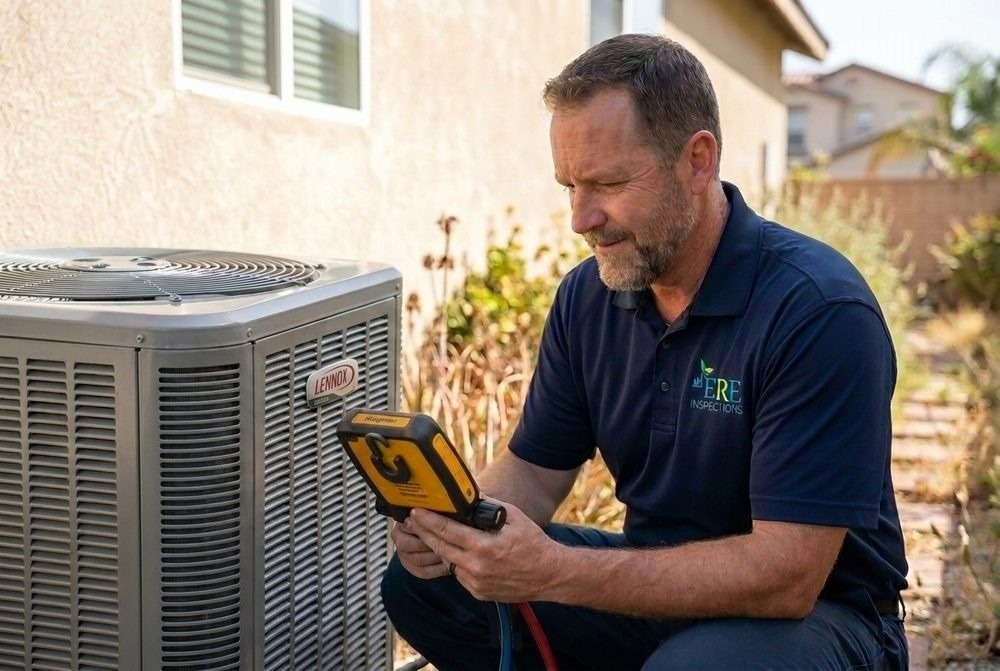
How it's tested. With the system running, we measure refrigerant pressures and line temperatures using calibrated digital probes and verify charge by the subcooling or superheat method; a CEC-approved fault indicator display on the equipment is an accepted alternative.
Code: §150.1(c)6–7; test procedure in Reference Appendix RA3.2.
Cooling-coil airflow
What it is. Verification that enough air actually moves across the indoor cooling coil — at least 350 CFM per ton of cooling capacity. A perfectly charged system still underperforms if undersized returns or restrictive filters starve the coil.
When it's required. Ducted space-conditioning systems on new construction and most system change-outs, whenever the CF1R lists airflow verification — it is normally paired with the fan watt draw test below.
How it's tested. We measure delivered airflow directly with a flow grid or powered flow hood, or by the plenum-pressure-matching method, with the system running at full cooling speed.
Code: §150.0(m)13; test procedure in Reference Appendix RA3.3.
Fan watt draw (fan efficacy)
What it is. A measurement of how much electricity the air handler fan uses to move each cubic foot of air. Title 24 caps fan efficacy at 0.45 watts per CFM for gas-furnace air handlers and 0.58 watts per CFM for all other systems.
When it's required. Alongside the cooling-coil airflow test — the two are measured simultaneously, because efficacy is the measured fan watt draw divided by the measured airflow.
How it's tested. We measure the fan's true power draw with a watt meter at the air handler while measuring system airflow, then divide. If the duct system is too restrictive, the number fails — which is exactly the design feedback the code intends.
Code: §150.0(m)13; test procedure in Reference Appendix RA3.3.4.
Blower door / envelope leakage
What it is. A whole-house air-tightness test. A calibrated fan mounted in an exterior doorway depressurizes the home to 50 pascals while we measure how much air leaks back in through the envelope — reported as CFM50 or air changes per hour (ACH50).
When it's required. It isn't mandatory on most homes — it's a performance-path credit: a verified-tight envelope lowers the energy model's budget, which energy consultants use to make tight designs pencil. The 2025 code also lets additions use tested envelope leakage with rater field verification (§150.2(a)1E).
How it's tested. Exterior openings closed, interior doors open, blower door to 50 Pa, leakage measured per Reference Appendix RA3.8.
What it costs. Market cost guides put a standalone residential blower door test at roughly $200–$600, averaging about $350 for a single-family home (HomeGuide). Bundled with other HERS measures on the same visit it runs less than a standalone trip — call for a fixed quote.
Code: §150.1(c) performance compliance credit and §150.2(a)1E; test procedure in Reference Appendix RA3.8.
Whole-dwelling ventilation & IAQ
What it is. Tight homes need deliberate fresh air. Title 24 requires continuous mechanical ventilation sized per ASHRAE Standard 62.2, and a rater must measure that the installed system actually delivers the design airflow — whether it's a dedicated exhaust fan, a supply fan, a balanced HRV/ERV (heat or energy recovery ventilator), or CFI (central fan integrated) ventilation, which draws outdoor air through a damper-controlled duct into the central air handler.
When it's required. All new dwelling units, and alterations where the CF1R calls for it. The 2025 code tightened multifamily: dwelling units must now use balanced or supply ventilation — exhaust-only whole-dwelling ventilation is no longer allowed — with unit compartmentalization verified by an ECC rater (§160.2(b)2Aivb). Prescriptively, multifamily units in climate zones 1, 2, 4, 11–14, and 16 need balanced HRV/ERV systems (§170.2(c)3B), and every HRV/ERV must have a fault indicator display the rater verifies in the field, per the CEC's multifamily fact sheet.
How it's tested. We measure the ventilation system's delivered airflow with a flow hood or flow meter and confirm controls and labeling, per Reference Appendix RA3.7.
Code: §150.0(o) (single-family), §160.2(b) (multifamily); test procedure in Reference Appendix RA3.7.
Kitchen range hood capture verification
What it is. Verification that the range hood actually installed in the kitchen is the one the ventilation design counted on — cooking is the biggest indoor air pollutant source in most homes.
When it's required. New dwelling units and alterations where the CF1R lists kitchen local exhaust verification.
How it's tested. This one is a directory check, not a fan test: we confirm the installed hood is ducted to the outdoors and that the exact model appears in the HVI or AHAM certified directory with a rated airflow or ASTM E3087 capture efficiency — and a sone (loudness) rating — meeting §150.0(o)1G for the dwelling's floor area and range fuel type. If the model isn't in the directory, it doesn't comply, per Energy Code Ace's RA3.7.4.3 reference.
Code: §150.0(o)1G; verification procedure in Reference Appendix RA3.7.4.3.
Quality Insulation Installation (QII)
What it is. A rater inspection of the insulation and air barrier before drywall covers them — checking that every cavity is filled with no gaps, voids, or compression, that headers, corners, and penetrations are insulated and sealed, and that the air barrier is continuous.
When it's required. QII is a prescriptive requirement for new single-family and low-rise multifamily construction and additions over 700 square feet, and a common performance-path credit on ADUs (accessory dwelling units) and remodels. The 2025 code carries it forward unchanged.
How it's tested. Visual inspection against the RA3.5 standard at the insulation stage — which makes timing critical: the visit must land after insulation and before drywall.
Code: Table 150.1-A; inspection procedure in Reference Appendix RA3.5. Full details on our QII verification page.
Heat pump water heater (HPWH) readiness
What it is. Heat pump water heaters (HPWHs) are effectively the 2025 prescriptive baseline for water heating — the gas-tankless prescriptive options were removed. Homes that still install a gas or propane water heater must be ready for a future HPWH swap: a dedicated branch circuit of at least 30 amps terminating near the water heater location, per §150.0(n)1Ai. HPWH installs themselves trigger minimum room-volume and ventilation rules (§110.3(c)7B). Multifamily buildings have parallel HPWH-ready mandates (§160.9).
When it's required. New construction permitted under the 2025 code, including single-family additions where water heating is in scope.
How it's verified. Honest note: this is an installer-certified item on the CF2R, not a rater diagnostic test. But it lives on the same compliance paperwork we close out, so we flag missing readiness items before they stall your final.
Code: §150.0(n)1Ai, §110.3(c)7B, §160.9.
PV and solar-ready notes
What it is. New low-rise homes in California prescriptively require a photovoltaic (PV) system sized from the home's energy model, and projects that defer PV under an exception must reserve a designated solar-ready roof zone with routed conduit and panel capacity per §110.10.
When it's required. New single-family and low-rise multifamily construction; the PV requirement has been prescriptive since the 2019 code took effect in 2020 and continues under 2025 (§150.1(c)14).
How it's verified. There is no HERS field test for PV — it's documented on the CF1R and CF2R and checked by the building department. We include it here because clients ask, and because PV sizing interacts with the same energy model that decides your other HERS measures.
Code: §150.1(c)14; §110.10.
Frequently asked
What is a HERS measure?
A HERS measure is an energy feature of a building that California's Title 24 energy code does not take on faith — it must be field-verified or diagnostically tested by a certified third-party rater before the building department signs off. Duct leakage, refrigerant charge, cooling-coil airflow, fan watt draw, ventilation airflow, and QII are the most common. Each verified measure is registered as a CF3R (Certificate of Verification).
Who decides which HERS measures my project needs?
Your energy consultant. The CF1R (Certificate of Compliance) prepared for your permit lists the measures that require field verification, and the building department holds your final until each one is tested and registered. Send us your CF1R and we'll tell you exactly which tests you need and quote the visit.
Did the 2025 Energy Code change which HERS measures are required?
Yes. For permit applications on or after January 1, 2026, the 2025 Energy Code makes heat pumps the prescriptive baseline in all 16 climate zones, requires refrigerant charge verification for heat pumps in every climate zone, requires balanced or supply ventilation in multifamily dwelling units, and adds rater verification of HRV/ERV fault indicator displays. Permits applied for before that date stay on the 2022 code.
Can all my HERS tests be done in one visit?
Usually. The HVAC measures — duct leakage, refrigerant charge, cooling-coil airflow, fan watt draw — plus the ventilation and range hood checks are typically done in a single visit once the system is running. QII is the exception: it has to be inspected before drywall, so it is always a separate, earlier visit.
What happens if a measure fails the test?
Your contractor corrects the issue and we retest. Failures are usually fixable on the spot or within days — sealing a duct connection, adjusting refrigerant charge, opening up return capacity. Catching it at the test visit is the point: it gets fixed before the building department final, not after.
Is a HERS rater the same as an ECC rater?
Yes. Under the 2025 Energy Code the California Energy Commission renamed the HERS compliance program to the Energy Code Compliance (ECC) program, so HERS raters and HERS providers became ECC raters and ECC providers on January 1, 2026. The tests, forms, and registration process are the same; ERE Inspections registers through CHEERS, an approved ECC provider and data registry.
Related Title 24 services
- Title 24 HERS / ECC Testing — Duct leakage, refrigerant charge, airflow, and fan efficacy — same-day registered results.
- Duct Leakage Testing — The most common HERS test on HVAC changeouts and duct replacements.
- Title 24 Reports (CF1R) — Energy calculations and the Certificate of Compliance for your permit.
- QII Verification — Quality Insulation Installation inspections before drywall, per RA3.5.
Not sure which measures your project needs?
Send us your CF1R — or just your permit scope — and we'll list exactly which HERS / ECC tests apply, quote a fixed price, and knock them out in as few visits as possible. LA, Orange County, and the Inland Empire.